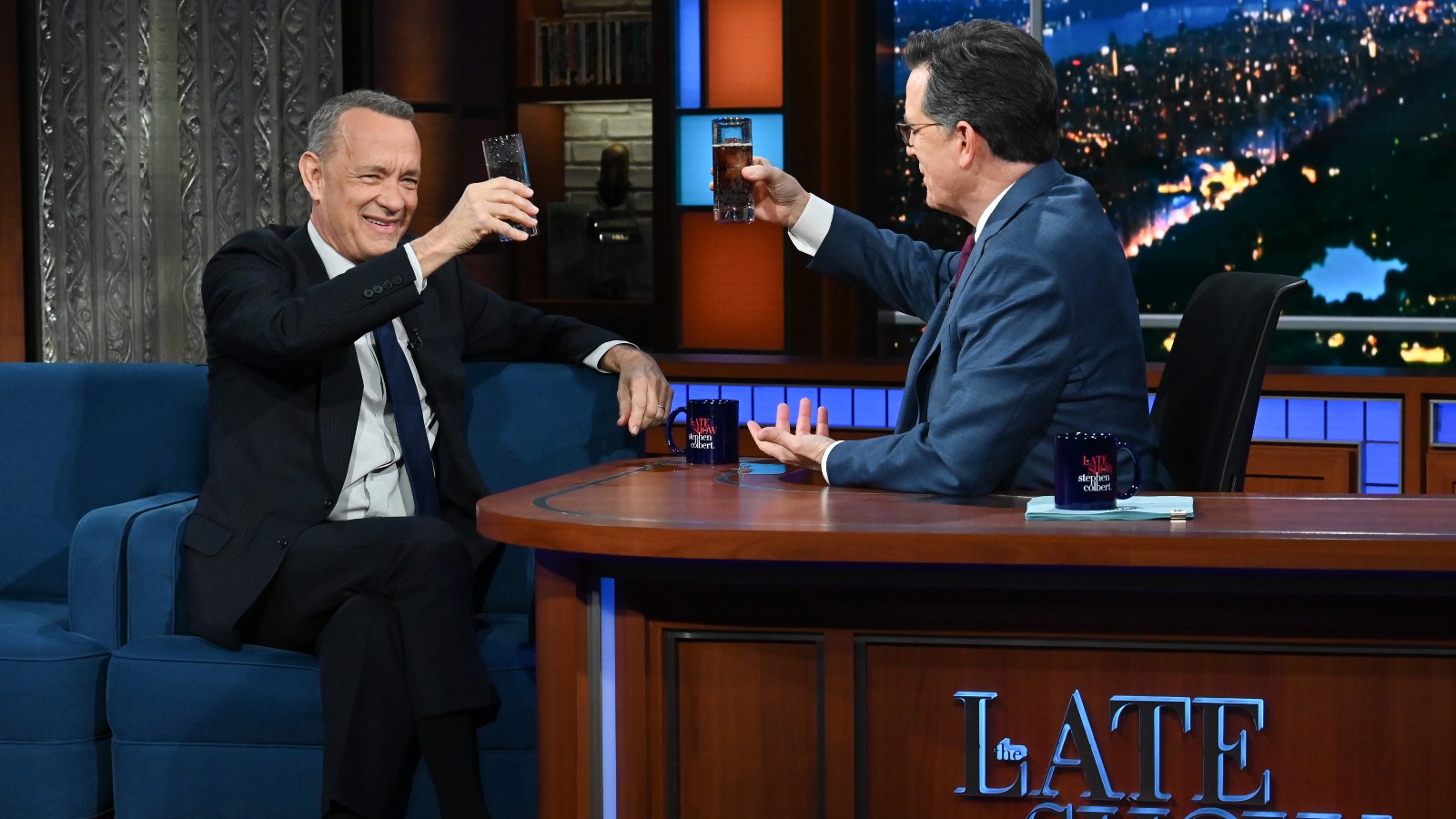
In the early hours of Sunday morning, social media platforms ignited with claims that Tom Hanks and Stephen Colbert had jointly launched a project called “Uncensored News,” allegedly drawing billions of views within a single day.
The announcement, which did not originate from any verified studio press release, immediately blurred the line between media reality, viral mythmaking, and a public increasingly primed to believe disruptive narratives.
According to circulating posts, the alleged collaboration promised “truth without filters,” “news without corporate oversight,” and a complete rejection of traditional broadcast constraints that define modern late-night television.

What accelerated the story was not proof, but plausibility, as both Hanks and Colbert are long associated with moral authority, political commentary, and deep trust among progressive audiences.
Within hours, short video clips, quotation graphics, and dramatic captions flooded feeds, creating the impression of a fully operational media platform before any confirmation emerged.
Media analysts note that viral velocity often replaces verification, especially when stories align with existing public frustrations toward mainstream news organizations.
The claim of “2.6 billion views in 24 hours” became the headline hook, despite experts pointing out that aggregated impressions across platforms are frequently inflated or misunderstood.
Still, the number mattered less than the symbolism, because it signaled hunger for something perceived as radical, independent, and emotionally validating.
Supporters described the rumored project as a long-overdue revolt against sanitized narratives, editorial gatekeeping, and advertiser-driven silence.
Critics immediately questioned whether the concept was even feasible, arguing that true independence is nearly impossible without institutional backing.
Others warned that “uncensored” branding often invites misinformation, conspiracy amplification, and emotional manipulation under the guise of authenticity.
The supposed first episode, described online as a fifteen-minute unscripted broadcast, was framed as evidence that traditional late-night formats are collapsing under public distrust.
Some viewers claimed the episode abandoned comedy entirely, replacing punchlines with sober monologues, documents, timelines, and open questions rather than conclusions.

That framing resonated deeply with audiences fatigued by spectacle but skeptical of authority.
Media scholars emphasize that Colbert’s satirical persona complicates interpretation, because irony is frequently misread as literal intent.
Tom Hanks’ involvement, if real, carried even heavier symbolic weight, given his long-standing image as “America’s moral narrator.”
The idea of Hanks stepping outside studio systems triggered strong emotional reactions across political and generational divides.
Conservative commentators accused the rumored project of disguising ideology as transparency.
Progressive supporters hailed it as a courageous refusal to obey corporate or political pressure.
Centrists questioned why audiences increasingly trust celebrities over journalists.

The story rapidly evolved from entertainment gossip into a referendum on media legitimacy.
Notably absent from the conversation was confirmation from Hanks, Colbert, CBS, Paramount, or any recognized production entity.
That silence did not slow the narrative.
Instead, it intensified speculation, as online audiences interpreted nonresponse as strategic secrecy rather than uncertainty.
Digital culture experts describe this as “confirmation by vacuum,” where lack of denial becomes perceived endorsement.
As debates raged, older Colbert clips resurfaced, retroactively framed as hints of rebellion.
Hanks’ past interviews discussing moral responsibility were reinterpreted as coded signals.
None of these connections were verifiable, but they felt coherent to audiences seeking meaning.
This phenomenon reflects a broader erosion of trust in institutional narratives.
In recent years, media consumers increasingly prefer stories that feel emotionally truthful, regardless of factual grounding.
“Uncensored News” became a symbol rather than a program.

It represented defiance, catharsis, and rebellion for some.
For others, it represented manipulation dressed as enlightenment.
The speed of reaction highlighted how late-night television is no longer seen as entertainment, but as political infrastructure.
When hosts speak, audiences interpret intention, allegiance, and threat.
Industry insiders caution that conflating celebrity speech with investigative journalism carries serious risks.
Without editorial safeguards, claims can spread unchecked, eroding public understanding.
Yet defenders argue that traditional safeguards themselves have failed, producing sanitized consensus instead of accountability.
This tension fuels the viral fire.
The rumored project’s framing as “outside corporate control” tapped into long-standing resentment toward media conglomerates.
Ironically, both Hanks and Colbert are deeply embedded within those same systems.
That contradiction became central to criticism.
Skeptics asked whether true independence is possible without financial transparency.
Others countered that moral independence matters more than structural purity.
As hashtags multiplied, platforms struggled to label the content accurately.
Some posts were flagged as misleading.
Others were boosted by engagement algorithms.
The result was narrative chaos.
Media watchdogs warned that fictionalized announcements can distort public discourse.
But they also acknowledged that public appetite for disruption is real.
Late-night television ratings have declined steadily over the past decade.
Trust in cable news has fallen alongside it.
The rumor landed in fertile ground.
Whether “Uncensored News” exists or not became secondary.
What mattered was what people wanted it to represent.
A break from scripted outrage.
A challenge to managed consensus.
A reclaiming of narrative agency.
Or simply another illusion designed to monetize attention.
As days passed, no verified episode appeared.
Yet discussion did not fade.
Commentary replaced content.
Reaction replaced reporting.
In that sense, the rumor succeeded regardless of truth.
It forced audiences to confront how desperately they crave authenticity.
It exposed how easily authority transfers from institutions to personalities.
And it revealed how fragile the boundary between journalism and performance has become.
If nothing else, the story demonstrates that modern media no longer needs confirmation to function.
It needs resonance.
It needs conflict.
It needs belief.
Whether Tom Hanks and Stephen Colbert launched anything at all may ultimately matter less than what America projected onto them.
In a fractured information landscape, even rumors become mirrors.
And this one reflected a nation unsure who to trust, but certain something is broken.
