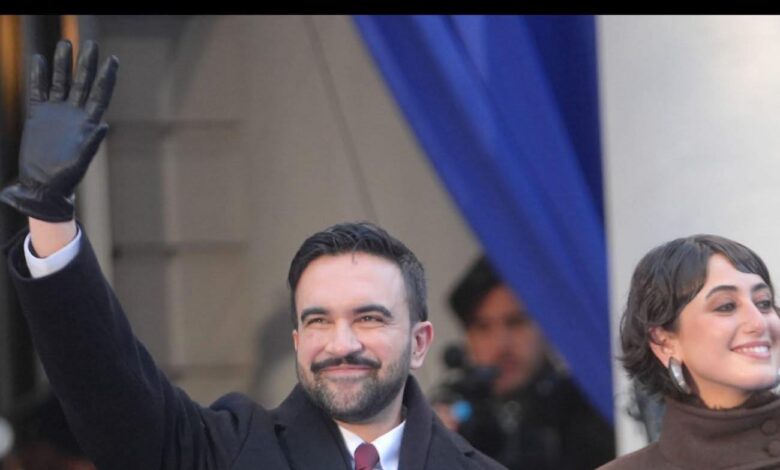
The political landscape of New York City shifted on its axis this Thursday as Zohran Mamdani, the newly minted mayor and a standard-bearer for democratic socialism, officially took the reins of the five boroughs. In a city where real estate is often considered the ultimate currency, Mamdani’s first hours in office were defined by a swift, aggressive strike against the status quo of the housing market. Less than two hours after his inauguration ceremony concluded, the 34-year-old mayor signed a trio of executive orders designed to dismantle traditional power structures and pivot the city toward a tenant-first reality. This opening salvo has sent tremors through the real estate industry and ignited a firestorm of debate that reaches far beyond the city limits, positioning New York as the primary battleground for the soul of the American left ahead of the 2026 midterm elections.
The setting for Mamdani’s announcement was as symbolic as the orders themselves. Eschewing the gilded halls of City Hall for his first press conference, the mayor stood before a rent-stabilized apartment building in Brooklyn. Against a backdrop of brick and fire escapes, on a day when thousands of New Yorkers were scrambling to meet their rent payments, he signaled that the era of political patience was over. “Today, we will not wait to deliver action,” Mamdani declared to a cheering crowd. “We will stand up on behalf of the tenants of this city and answer to all New Yorkers, not to any billionaire or oligarch who thinks they can buy our democracy.”
The centerpieces of this radical new agenda are three distinct executive orders, each targeting a different bottleneck in the city’s notoriously dysfunctional housing system. The first order was the formal resurrection of the Mayor’s Office to Protect Tenants. This body is designed to act as a centralized command center for renter advocacy, tasked with coordinating city agencies to move against landlords who maintain unsafe or illegal living conditions. To lead this reinvigorated office, Mamdani tapped Cea Weaver, a name that strikes fear into the hearts of the city’s major property owners. Weaver was a primary architect of the landmark 2019 Housing Stability and Tenant Protection Act, and her appointment signals that the administration intends to use every legal lever available to shift the balance of power toward those who pay rent rather than those who collect it.
Mamdani’s second directive focused on the physical scarcity of housing. He established the Land Inventory Fast Track (LIFT) Task Force, an initiative led by Deputy Mayor for Housing and Planning Leila Bozorg. The mandate for LIFT is clear and time-sensitive: conduct a comprehensive audit of all city-owned properties and identify every site suitable for residential development by July 1, 2026. By prioritizing city-owned land, Mamdani is signaling a move toward social housing—development that circumvents the profit motives of private developers in favor of permanent affordability.
Recognizing that even the most ambitious social housing projects can be choked by red tape, the mayor’s third order created the Streamlining Procedures to Expedite Equitable Development (SPEED) Task Force. This body, co-led by Bozorg and Deputy Mayor of Operations Julia Kerson, aims to identify and slash the bureaucratic hurdles and permitting delays that traditionally drive up construction costs. Mamdani’s argument is that by removing these “permitting barriers,” the city can make it both cheaper to build and easier for low-income residents to access new units. This “Speed” initiative is a tactical attempt to bridge the gap between progressive ideology and the practical, gritty realities of New York’s construction industry.
The political theater of the inauguration itself was a testament to Mamdani’s national stature within the Democratic Socialists of America. The ceremony featured high-profile endorsements from U.S. Senator Bernie Sanders and U.S. Representative Alexandria Ocasio-Cortez. Sanders, whom Mamdani has cited as his primary political inspiration, used his time at the podium to defend the new mayor’s “radical” agenda. “Making sure that people can live in affordable housing is not radical,” Sanders told the crowd. “It is the right and decent thing to do.” Sanders leaned into his signature rhetoric, calling for increased taxes on the wealthy to fund these urban social programs, a message that resonated deeply with the local crowd but provided immediate ammunition for Mamdani’s critics.
The reaction from the Republican Party and more moderate centrist factions was swift and vitriolic. To his detractors, Mamdani’s first day in office represents a dangerous “socialist experiment” that could lead to capital flight and a collapse of the city’s tax base. National Republican strategists have already begun casting Mamdani as a foil, using his administration as a warning of what they claim is the “radicalization” of the Democratic Party. As the 2026 midterms approach, the performance of the Mamdani administration will likely be used as a litmus test for the viability of democratic socialism on a large scale.
Mamdani’s rise comes at a complicated moment for the national political mood. While the mayor campaigned on the crushing cost of living, he enters office at a time when President Donald Trump’s approval ratings have seen a steady uptick. This shift is largely attributed to a recent decline in gasoline prices and a slight easing of general consumer inflation. Mamdani, a vocal critic of the President, must now prove that his local, structural interventions can provide a more meaningful and lasting relief to New Yorkers than the fluctuating macroeconomic trends seen at the federal level.
For many New Yorkers, the “uproar” is a mixture of hope and trepidation. Tenants in neighborhoods facing rapid gentrification see Mamdani as a long-awaited shield against displacement. Conversely, small-scale property owners and the broader business community fear that “intensifying pressure on landlords” will lead to a decrease in building maintenance and a stifling of new investment. The mayor remains undeterred by the polarized reception. “I was elected as a democratic socialist, and I will govern as a democratic socialist,” he reaffirmed, leaning into the controversy rather than shying away from it.
As the first week of the Mamdani administration unfolds, the eyes of the nation are fixed on New York City. The success or failure of the LIFT and SPEED task forces will provide the first tangible evidence of whether a socialist housing agenda can survive the complexities of the city’s bureaucracy. For now, Mamdani has succeeded in his first goal: he has disrupted the conversation and placed housing at the absolute center of his governing identity. In a city that never sleeps, the new mayor has ensured that New York’s landlords and tenants alike will be wide awake, watching his every move.
