What looked like a routine oversight hearing suddenly became one of the most uncomfortable and politically revealing confrontations Washington has seen in months.
Within minutes, the room shifted from procedure to pressure, and from pressure to the kind of silence that makes unanswered questions feel louder than any speech.
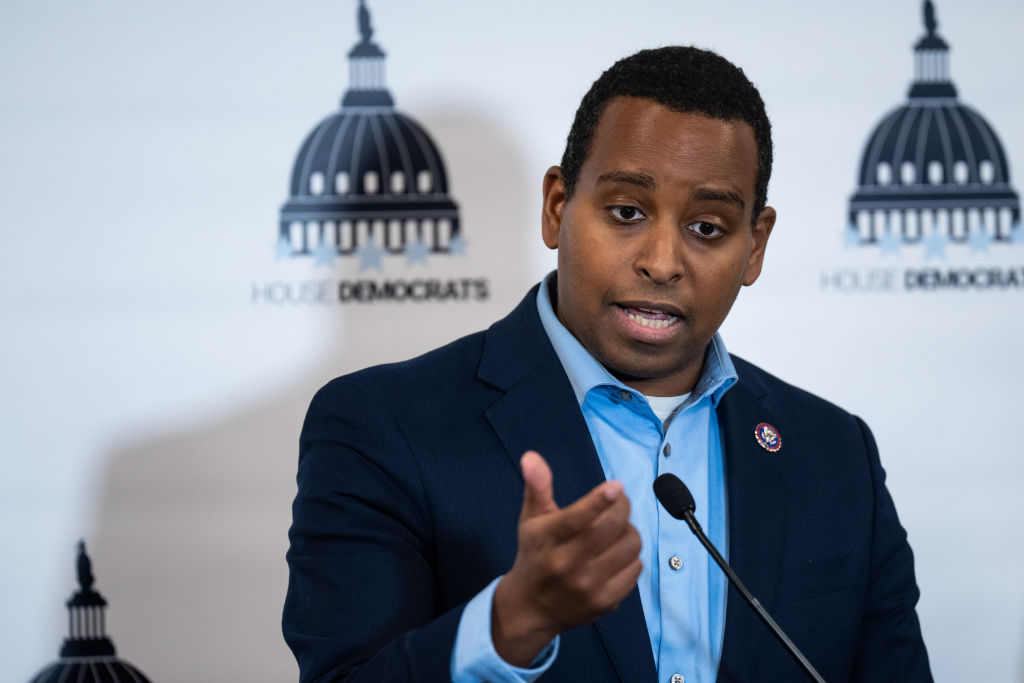
Congressman Joe Neguse did not arrive with a grand monologue or a theatrical prop designed only for headlines.
He arrived with something more dangerous in a hearing room, a short video, a few hard numbers, and a series of questions simple enough that every dodge felt impossible to miss.
That is what made the exchange so explosive.
It was not built on wild rhetoric, but on the oldest and most effective oversight method in politics, ask a plain question, ask it again, and let the evasion speak for itself.
The first strike came fast.
Neguse referenced Pam Bondi’s public posture as a fierce defender of law enforcement and then introduced a clip designed to test whether that message actually matched the choices made under her leadership.
The video was not subtle.

It showed a man shouting at police officers during the chaos of January 6, hurling insults, escalating rage, and, according to the exchange, yelling words no public official should be comfortable shrugging off.
Then Neguse asked the question that made the room tighten.
That man works for the Department of Justice now, right.
Bondi confirmed that he did.
And in that instant, the hearing stopped being theoretical and became a direct confrontation over whether public messaging about “backing the blue” was anything more than branding.
Neguse drove the point with precision.
He was not arguing over whether a pardon exists in the abstract, but over what it means when the Justice Department hires someone whose conduct toward police had already become part of the public record.
That distinction matters politically.
A pardon can erase punishment, but it does not erase optics, memory, symbolism, or the public’s right to ask what values a department is signaling when it makes a hire like that.
For supporters of Bondi, the legal answer may seem enough.

If the person was pardoned, then the person is legally eligible, and the matter is closed.
But that was never the whole point of Neguse’s challenge.
His point was that a department claiming moral clarity on law enforcement cannot expect the public to ignore the moral ambiguity of whom it chooses to bring inside the building.
That is why the moment hit so hard.
It forced a collision between rhetoric and reality, and once that collision is visible on camera, the political damage often comes not from the answer, but from the contrast.
Neguse did not stop there.
He shifted from the emotional charge of January 6 to something far more bureaucratic, and in Washington, bureaucratic questions are often the ones that do the deepest damage.
He turned to the Public Integrity Section.

That office exists for a reason, and not a trivial one, because it was born in the wake of Watergate as part of the country’s effort to confront official corruption with dedicated institutional muscle.
Neguse asked a simple question about it.
How many people worked there when Bondi took office, and how many remain now.
It was the kind of question any normal oversight hearing should be able to handle cleanly.
A number, a staffing count, a straightforward explanation, and then the hearing moves on.
But that is not what happened.
Instead of answering directly, Bondi pivoted toward broader political language about “weaponization,” priorities, and the familiar vocabulary officials use when they want the room to stop listening for facts and start listening for ideology.
Neguse would not let that work.
He reclaimed his time, clarified that the question was not tricky, and made it clear that the point of the hearing was not to collect slogans, but to understand what had actually happened inside the department.
That is when the exchange became a miniature case study in modern political evasion.
Ask for a number, get a narrative.
Ask about staffing, get a talking point.
Ask what exists now, get an argument about the past.
The public sees this pattern instantly.
People may disagree about policy, but they can tell when a witness is answering the question and when a witness is circling around it, hoping procedure will run out before clarity arrives.
Neguse then turned to cryptocurrency enforcement, and that may have been the most politically loaded pivot of the day.
Because if the Public Integrity Section question touched anti-corruption capacity, the crypto question touched the future of money, influence, and whether federal enforcement is being weakened right as politically connected fortunes grow around digital assets.
Again, his question was brutally simple.
How many people work for the National Cryptocurrency Enforcement Team.
Again, no clear number came.
Again, the answer drifted.
And once it drifted, Neguse made the move that turned discomfort into accusation.
He suggested the reason no number was forthcoming was because the team had effectively been eliminated.
That claim carries enormous political force.
Not just because cryptocurrency is controversial, but because crypto now sits at the intersection of private wealth, regulatory uncertainty, campaign culture, and the public fear that fast-moving money can outrun slow-moving law.
In that context, the disappearance of a specialized enforcement team is not a side issue.
It becomes a symbol of whether the government still intends to police the most complex financial terrain in the country or whether it is quietly stepping back just as the stakes grow larger.
Neguse connected that possibility to a larger ethical concern.
If powerful people with influence over policy also stand to benefit from weaker crypto enforcement, then the staffing question is no longer administrative, but political, moral, and deeply public.
That is why the exchange spread so fast after the hearing.
It had the structure of a viral political moment, but it also had the substance of a real accountability test.
A video clip, a confirmed hire, a gutted anti-corruption unit, a vanished crypto team, and an attorney general who seemed unable or unwilling to answer basic questions cleanly.
That combination is combustible.
Bondi’s defenders will say this was a hostile setup.
They will argue that oversight hearings are too often engineered to create clips rather than understanding, and that officials should not be expected to indulge every premise embedded in an opponent’s questioning.
That defense is not frivolous.
But it runs into a basic problem in this case, because Neguse’s questions were not overly complex, classified, or speculative.
They were operational.
Who works here, how many remain, why was this person hired, does that team still exist.
These are not impossible questions.
And when impossible-looking evasions are used to answer possible questions, viewers begin to suspect that the underlying facts are politically inconvenient.
That is the real danger for any official under oath or under camera.
Not merely being challenged, but looking like someone who cannot answer the most basic oversight questions without trying to change the frame of the hearing itself.
Neguse understood that dynamic and exploited it effectively.
He did not need a dramatic confession or a smoking gun to make his case, because the cumulative effect of unanswered basics can be just as powerful as any explosive revelation.
In some ways, that made the hearing more unsettling.
There was no climactic admission, no clean collapse, no single instant that resolved everything.
Instead, there was a series of plain questions and a widening sense that the person in charge of the department was more comfortable contesting the tone of the hearing than explaining the structure of the institution she leads.
That kind of tension lingers.
It lingers because it goes to the heart of what oversight is supposed to mean.
Congress is not only there to hear values, but to test facts.
When facts become strangely difficult to obtain, the public starts drawing its own conclusions.
And those conclusions are rarely kind to institutions already struggling to prove their neutrality, consistency, and seriousness.
This is why the hearing felt bigger than one clash between one congressman and one attorney general.
It became a referendum on whether the Department of Justice is still willing to be transparent about its own internal priorities when the questions become politically uncomfortable.
The first issue was loyalty versus law enforcement credibility.
The second was anti-corruption capacity.
The third was crypto enforcement in an era of expanding political wealth.
Taken together, those issues formed a much darker picture than any one exchange could have carried on its own.
That is what made Bondi look off guard.
Not simply that Neguse came prepared, but that he arranged the hearing into a sequence where every non-answer deepened the next question rather than escaping it.
The result was devastatingly simple.
By the end of the exchange, the most memorable parts were not Bondi’s explanations, but the spaces where explanations should have been.
A hearing room dedicated to accountability had produced a string of unanswered basics.
And in politics, nothing raises suspicion faster than an official who can deliver a message fluently but cannot deliver a number.
That is why this moment will keep circulating.
Not because it settled every argument, but because it distilled a larger national fear into a few unforgettable minutes, that institutions still speak in the name of justice while growing strangely evasive about their own machinery.
Neguse did not need fireworks to make that point.
He only needed receipts, a steady voice, and the patience to let silence do the rest.
