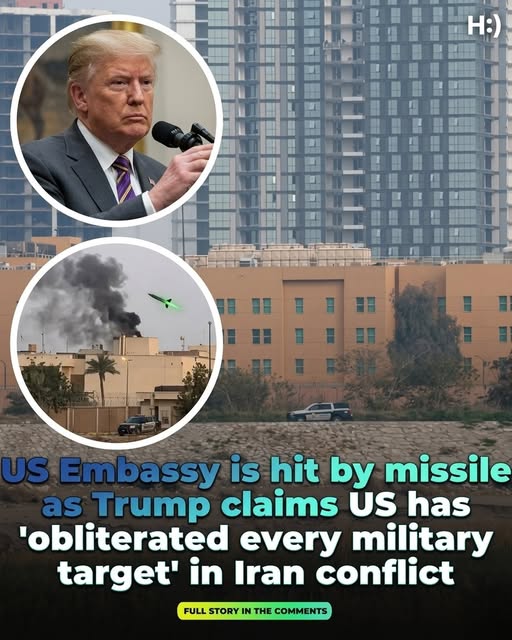
A missile strike landed inside Baghdad’s heavily fortified Green Zone late Friday night, near the United States Embassy compound, raising fresh concern about the growing tension between the United States and Iran. The Green Zone houses Iraqi government institutions, foreign embassies, and key security installations, and incidents there are watched closely because they often signal broader regional instability.
Videos shared online showed smoke rising near the diplomatic area, though early reports did not confirm casualties or the full extent of the damage. Both Iraqi and U.S. officials began assessing the situation while increasing security around diplomatic facilities.
The strike came only hours after former U.S. President Donald Trump announced that American forces had carried out a major military operation against Iranian-linked targets. According to his statement, several military-related sites were struck as part of an effort to weaken networks connected to Iran-backed groups operating in the region.
One reported location targeted during the operation was Kharg Island, a key hub for Iran’s oil exports in the Persian Gulf. The island is widely considered a vital piece of Iran’s energy infrastructure. Trump said that while the area was attacked, U.S. forces deliberately avoided damaging the oil export facilities themselves, focusing instead on military assets.
The broader campaign was described as part of an operation aimed at reducing the military capabilities of Iran-aligned groups active across parts of the Middle East. In recent weeks, those groups have reportedly launched drones and missiles toward American military bases and diplomatic compounds, particularly in Iraq.
At the same time, political developments inside Iran have added another layer of uncertainty. Following the death of longtime Supreme Leader Ali Khamenei, leadership has reportedly shifted to his son, Mojtaba Khamenei. His early public statements have suggested a more confrontational stance toward the United States and its allies.
Iranian leaders have indicated that they intend to respond to what they describe as major losses from the conflict, signaling that further retaliation could occur. Each new strike or response risks tightening a cycle that becomes harder to slow once it begins.
Another point of concern among international observers is the Strait of Hormuz, one of the most important oil transit routes in the world. A large portion of global oil shipments passes through the narrow waterway each day. Any disruption there could affect energy markets worldwide and deepen the economic consequences of the crisis.
For now, governments across the world are watching the situation closely. Moments like this carry a familiar danger: when actions and reactions begin to move quickly, even small misjudgments can widen a conflict beyond what anyone originally intended.
The coming days will likely determine whether the current tension stabilizes or continues to escalate. In such moments, restraint and careful communication often matter as much as military strength, because preventing a wider conflict ultimately serves the interests of everyone involved.
